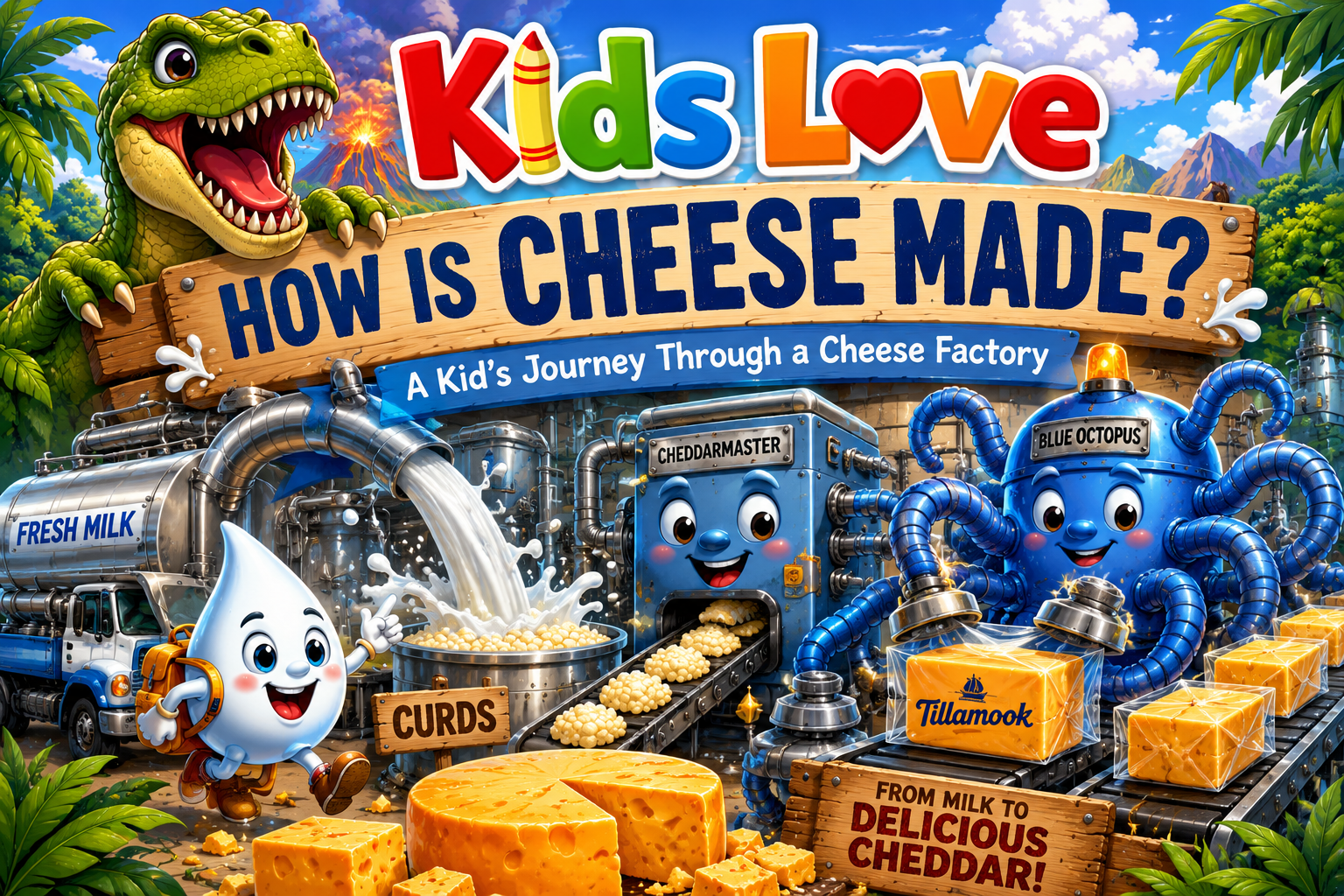
Have you ever wondered how cheese is made?
We wondered the same thing when we visited the Tillamook Creamery on the Oregon coast.
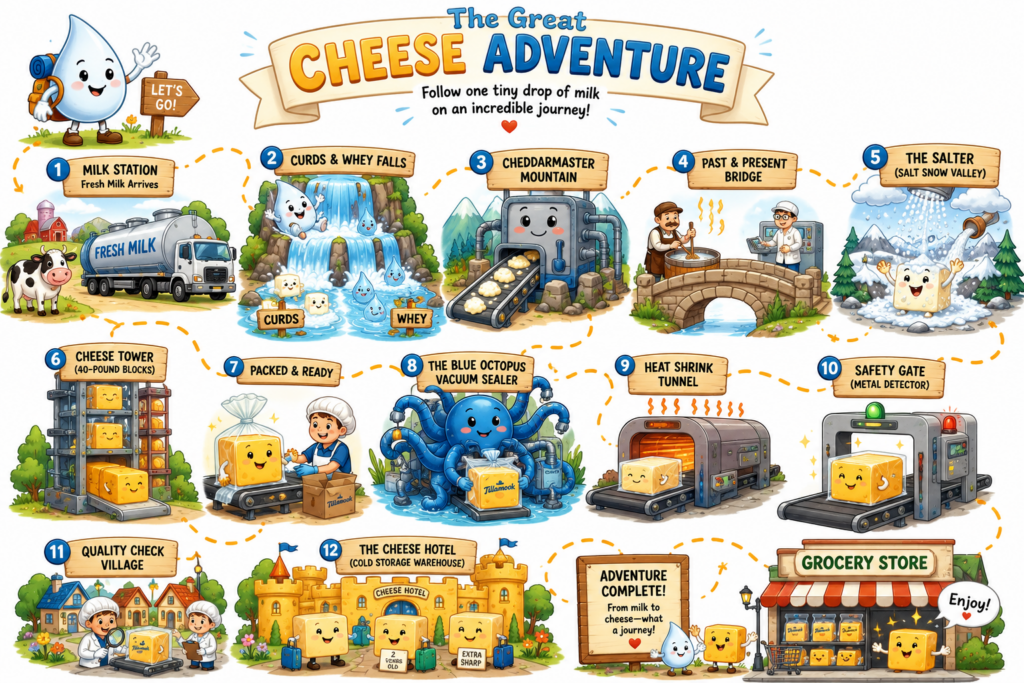
We watched milk travel through giant pipes, become curds and whey, pass through machines with names like the Cheddarmaster and the Blue Octopus, and eventually become the cheddar cheese you find in grocery stores.
Before our visit, I thought cheese was probably made in one or two simple steps.
I was wrong.
Making cheddar cheese is a fascinating journey that combines science, engineering, history, and a whole lot of patience.
Come along and let’s follow the adventure of a drop of milk as it becomes a block of cheddar cheese!
What Is Cheese Made From?
Every block of cheddar cheese begins with just a few simple ingredients:
🥛 Fresh milk
🦠 Starter cultures (good bacteria)
🧪 Rennet (an enzyme that helps milk thicken)
🧂 Salt
That’s it!
But when those ingredients come together, something amazing happens.
How Does Milk Become Cheese?
The first thing cheesemakers do is bring fresh milk into giant stainless-steel vats.
The vats are enormous.
Some hold more than 53,000 pounds of milk at one time!
Special cultures and rennet are added to the milk.
Soon, the milk begins to change.
What started as a liquid slowly thickens until it separates into two parts:
🧀 Curds
💧 Whey
This is one of the most important steps in the entire cheese-making process.
What Are Curds and Whey?
If you’ve ever heard the nursery rhyme about Little Miss Muffet, you’ve already heard about curds and whey.
Curds are the solid pieces that eventually become cheese.
Whey is the liquid that remains behind.
When we visited the creamery, it was amazing to learn that cheesemakers don’t waste the whey. It gets turned into other products, including protein powders and ingredients used in foods all over the world.
Nothing goes to waste.
Meet the Cheddarmaster
One of the coolest machines we saw was called the Cheddarmaster.
Honestly, it sounds like the name of a superhero.
Inside the Cheddarmaster, the curds travel along giant conveyor belts.
As they move:
- More whey drains away
- The curds stick together
- The curds are stretched and folded
- The texture begins to change
This process is called cheddaring.
In fact, it’s one of the things that makes cheddar cheese different from many other cheeses.
Without cheddaring, cheddar wouldn’t be cheddar!
How Did People Make Cheese Before Machines?
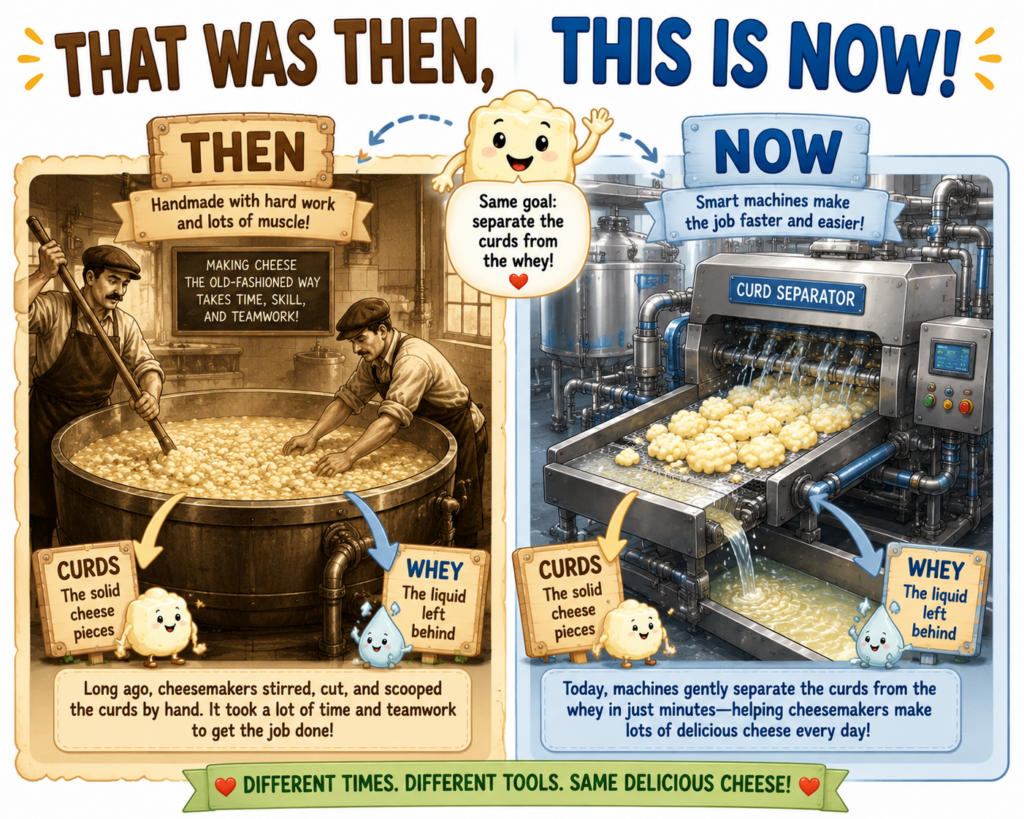
One of my favorite stops on the tour was called Past and Present.
Long before giant factories existed, cheesemakers made cheddar by hand.
They worked with long open vats and spent hours:
- Stacking curds
- Flipping curds
- Stretching curds
- Repeating the process over and over
Today, machines help do much of that work.
But the goal hasn’t changed.
Modern cheesemakers are still using many of the same ideas that cheesemakers used over 100 years ago.
Why Do Cheesemakers Add Salt?
Next, the cheese enters a machine called the Salter.
At first, I thought salt was only added for flavor.
It turns out salt does much more than that.
Salt helps:
🧂 Improve flavor
💧 Remove extra moisture
🦠 Slow down bacterial activity
📦 Preserve the cheese
Without salt, cheddar cheese wouldn’t develop its familiar taste and texture.
How Are Giant Blocks of Cheese Made?
This part was incredible.
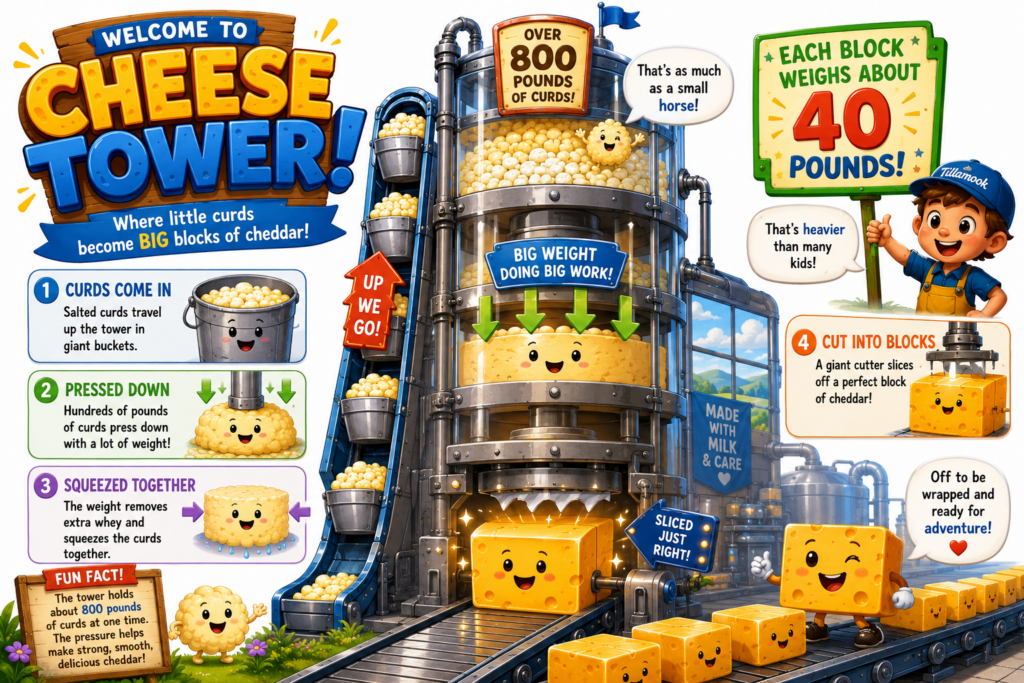
The salted curds are sent into tall towers that hold about 800 pounds of cheese curds.
That’s about as much as a small horse weighs!
The weight of all those curds presses down on the cheese below.
Slowly, the curds squeeze together and become solid blocks of cheddar.
Then a giant blade cuts off a block weighing about 40 pounds.
That’s heavier than many elementary school students!
Watching block after block emerge from the tower felt a little like watching a giant cheese vending machine.
Packed and Ready
Once the blocks are formed, workers quickly place special plastic bags around them.
The cheese keeps moving down the line while workers and machines work together to keep everything running smoothly.
This was one of the moments where I realized how much teamwork goes into making cheese.
Even with giant machines, people are still an important part of the process.
🦖 Rex’s Cheese Fact
Did you know?
Nobody knows if T. rex liked cheese.
Cheese wasn’t invented until millions of years after dinosaurs disappeared!
But if Rex could visit a cheese factory today, we’re pretty sure he’d ask for the biggest block of cheddar they had.
Meet the Blue Octopus
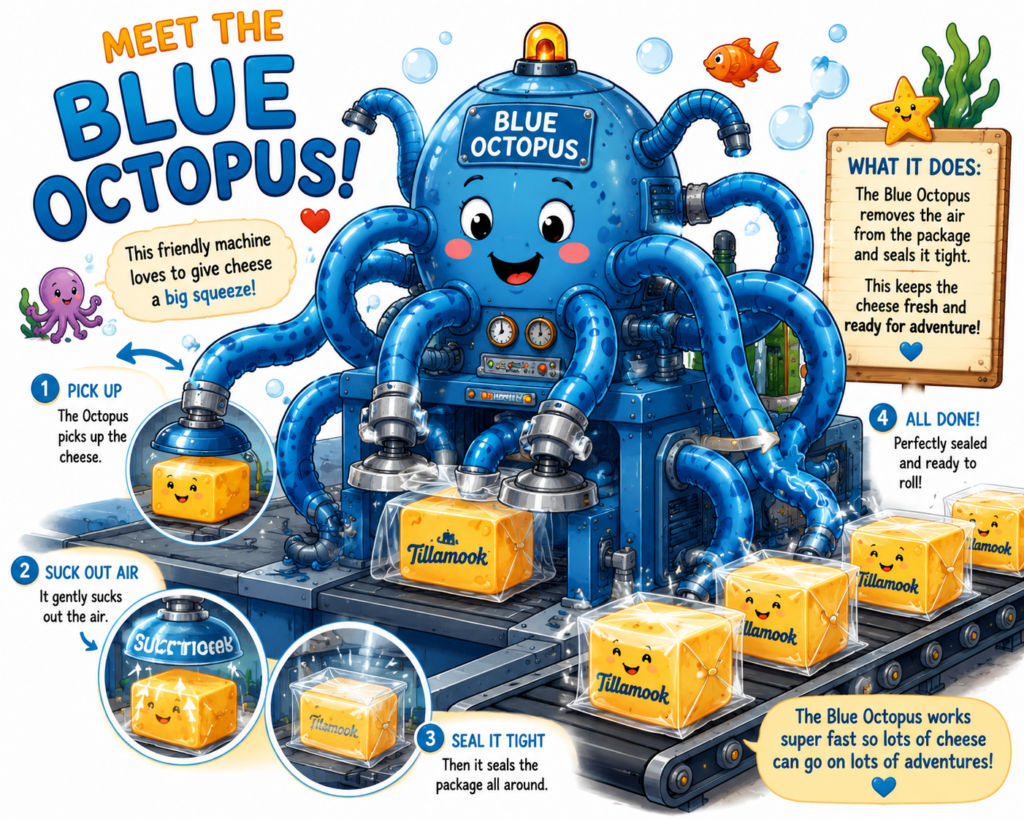
This was probably the most memorable machine in the entire factory.
It’s called the Blue Octopus because of the bright blue tubes that stick out from the machine like octopus arms.
The Blue Octopus removes air from the package and seals it tightly around the cheese.
This process is called vacuum sealing.
By removing the air, the cheese stays fresher and can age properly.
No real octopuses are involved in cheese-making.
At least, none that we saw.
The Heat Shrink Tunnel
After leaving the Blue Octopus, the cheese travels through a warm tunnel.
The heat causes the packaging to shrink tightly around the cheese.
Think of it like wrapping a present perfectly.
When the cheese comes out the other side, the package looks neat, smooth, and secure.
The Metal Detector
Before the cheese can move on, every package passes through a metal detector.
Just like security at an airport, the machine checks for anything that shouldn’t be there.
Food safety is incredibly important, and this is one of the many ways cheesemakers help protect consumers.
The Quality Checkpoint
Even after all the machines have done their work, real people still inspect the cheese.
Workers check:
✅ Package seals
✅ Date codes
✅ Appearance
✅ Packaging quality
If something doesn’t look right, it gets removed from the line.
I thought this was pretty cool because it shows that people still play an important role in modern factories.
Why Does Cheese Age?
Many blocks of cheddar aren’t shipped immediately.
Instead, they spend months—or even years—in a giant refrigerated warehouse.
As cheddar ages:
🧀 Its flavor becomes stronger
🧀 Its texture changes
🧀 Its color may deepen
🧀 Tiny flavor crystals can form
This is why aged cheddar tastes different from mild cheddar.
They’re made the same way.
The aged cheddar has simply had more time to develop its flavor.
The Cheese Hotel
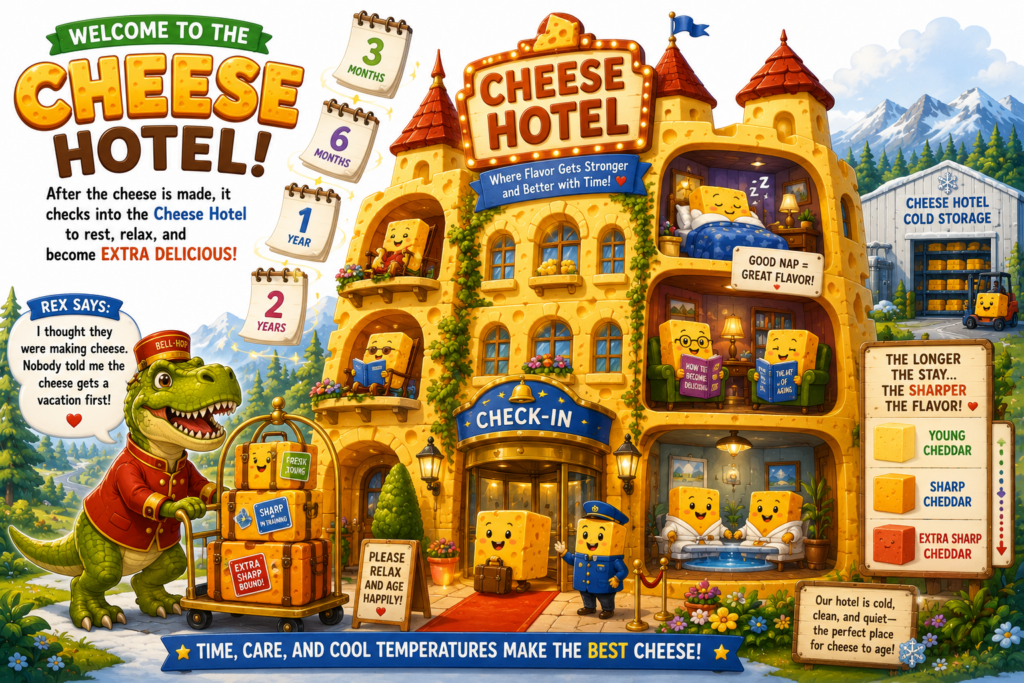
I like to think of the warehouse as a giant hotel for cheese.
The cheese checks in.
It waits.
It ages.
Then one day it checks out and heads off to grocery stores around the country.
Not a bad life for a block of cheddar.
🦖 Rex’s Question: So the cheese gets a vacation before I eat it?”
How Does Cheese Get to Stores?
After packaging, inspection, and aging, the cheese is loaded for shipping.
Some blocks stay large.
Others are cut into smaller pieces.
Eventually, they make their way to grocery stores, restaurants, and kitchens.
The next time you enjoy a grilled cheese sandwich, a cheeseburger, or macaroni and cheese, remember:
That block of cheddar went on quite an adventure before it reached your plate.
Fun Cheese Facts
🧀 It takes about 10 pounds of milk to make 1 pound of cheese.
🧀 Some cheese vats hold more than 53,000 pounds of milk.
🧀 The Cheddarmaster can hold about 15,000 pounds of curds.
🧀 Block-forming towers can hold 800 pounds of curds at one time.
🧀 A cheddar block weighs about 40 pounds.
🧀 Some cheddar cheeses age for months or even years before reaching stores.
Frequently Asked Questions About Cheese
How is cheese made?
Cheese is made by adding cultures and rennet to milk. The milk separates into curds and whey. The curds are then processed, salted, formed into blocks, aged, packaged, and shipped.
How is cheddar cheese made?
Cheddar cheese is made using a special process called cheddaring, where curds are stretched, folded, and pressed together before aging.
What are curds and whey?
Curds are the solid parts of milk that become cheese. Whey is the liquid left behind after the milk separates.
Why is cheddar cheese orange?
Some cheddar cheese contains a natural coloring called annatto, which comes from the seeds of a tropical plant.
How long does it take to make cheddar cheese?
The first stages happen in hours, but many cheddar cheeses age for months or even years before they are sold.
The next time someone asks you “How is cheese made?”, you’ll know the answer.
It starts with milk, passes through giant machines, survives the Blue Octopus, relaxes in the Cheese Hotel, and eventually finds its way to your plate. 🧀✨
🦖 Rex Says…
“If I had tiny arms and a giant block of cheddar, I’d still find a way to eat it.”