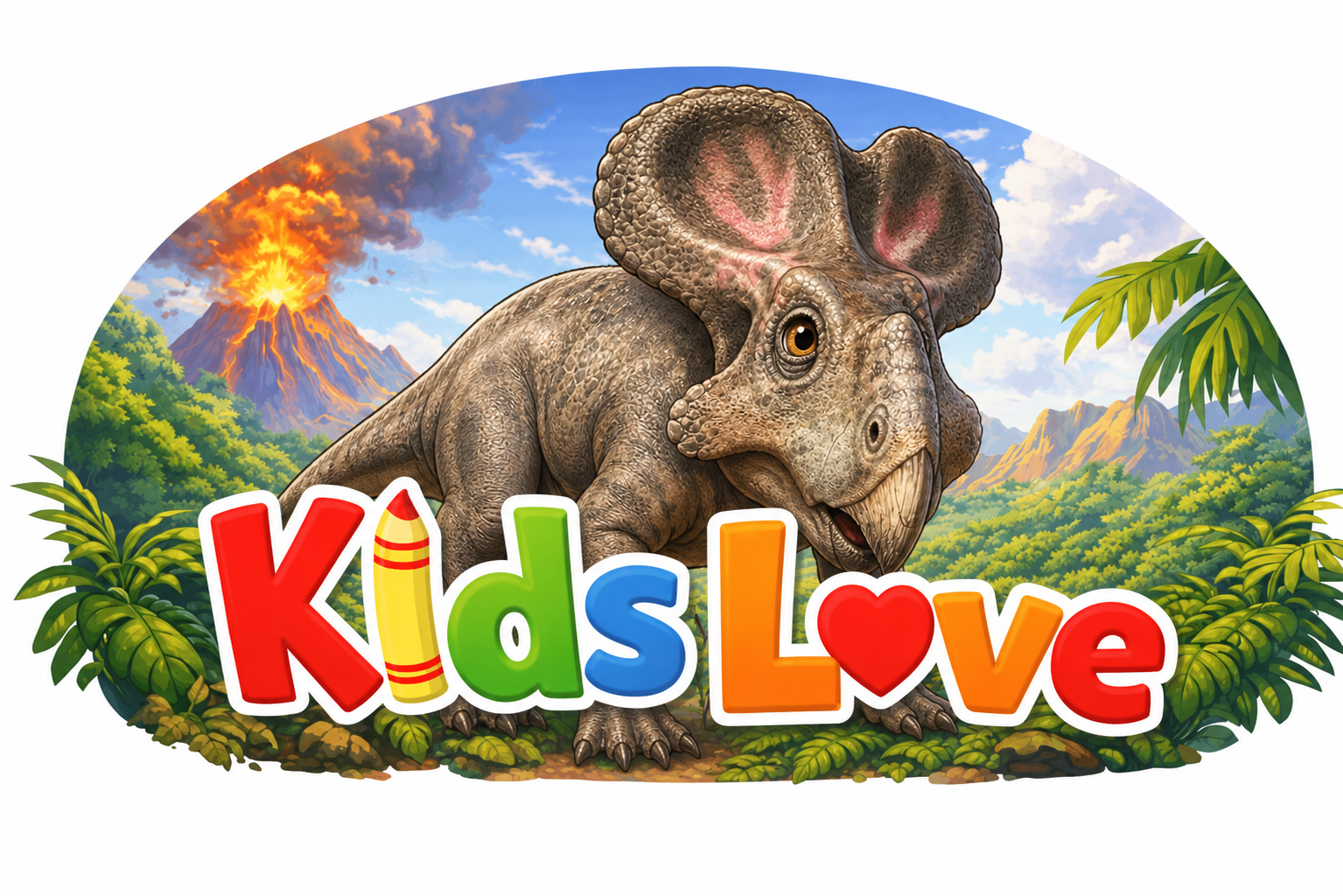
Long ago, in the sandy deserts of Mongolia, a small but mighty dinosaur called Protoceratops marched through the dunes. It didn’t have huge horns or teeth like T. rex, but it had a big frill and a strong beak that made it stand out.
This plant-eating dinosaur was an early member of the horned dinosaur family—the same group that later produced Triceratops! Scientists sometimes call it a “prototype” or early version of its larger relatives.
Protoceratops lived about 75 million years ago, and its fossils help paleontologists understand how horned dinosaurs grew, behaved, and protected themselves.
Let’s dig into some amazing Protoceratops facts for kids and learn all about this cool creature from the Age of Dinosaurs!
Quick Facts:
- Name Meaning: “First horned face”
- Length: About 6 feet (1.8 meters)
- Height: Around 2 feet (0.6 meters) tall at the shoulders
- Diet: Herbivore (plant-eater)
- Time Period: Late Cretaceous, about 75–71 million years ago
- Lived: Deserts and dry plains of ancient Mongolia and China
- Fossils Found In: The Gobi Desert (Mongolia and northwest China)
How Was Protoceratops Discovered?
Protoceratops was first discovered in the early 1920s by scientists from the American Museum of Natural History, led by Roy Chapman Andrews. The team found incredible fossils in the Gobi Desert of Mongolia.
One of the biggest surprises was a fossil showing a Protoceratops locked in battle with a Velociraptor. This rare “fighting fossils” discovery gave a snapshot of real dinosaur behavior!
The name Protoceratops andrewsi honors both its early place in the horned dinosaur family and Roy Chapman Andrews, who helped uncover it.
Where Did Protoceratops Live?
When we ask “where did Protoceratops live,” the answer takes us to the ancient Gobi Desert. Back then, this area wasn’t the dry place we see today—it had sand dunes, small streams, and patches of plants.
Fossils show that Protoceratops lived in herds or groups, perhaps to stay safe from meat-eating dinosaurs like Velociraptor. Eggs and nests found in the same rock layers suggest they built nests and cared for their young.
What Did Protoceratops Eat?
So, what did Protoceratops eat? Mostly tough, desert plants. Using its sharp, parrot-like beak, it could bite through thick leaves and fibrous stems.
It probably fed close to the ground, nibbling on ferns, cycads, and other low shrubs. Its beak worked like garden shears—snipping off plant pieces to chew them up.
Protoceratops Skull, Teeth, and Jaws
Protoceratops had one of the most recognizable skulls of any small dinosaur. Its head was large compared to its body, with a bony frill that extended over its neck.
Unlike its famous cousin Triceratops, Protoceratops didn’t have big horns—just small bumps above its nose and eyes. Its teeth were shaped like little leaf cutters, perfect for slicing plants.
The strong jaw and beak helped it grind food efficiently, and the frill may have helped protect its neck or been used to attract mates.
How Big Was Protoceratops?
Protoceratops was about the size of a large sheep or a medium-sized dog. Adults reached up to 6 feet long and weighed around 400 pounds.
That might sound small for a dinosaur, but it was powerful for its size, with a sturdy body designed for survival in harsh desert environments.
The Dinosaur Family Tree
Protoceratops belonged to a group called Ceratopsians, or horned dinosaurs. These dinos all had beaks, frills, and plant-based diets.
Other members of its family include:
- Triceratops – the three-horned giant from North America
- Leptoceratops – a small horned dinosaur like Protoceratops
- Psittacosaurus – an even earlier beaked dinosaur
- Centrosaurus – a medium-sized ceratopsian with one big nose horn
- Styracosaurus – known for its long, spiky frill horns
Protoceratops Name Meaning
The name Protoceratops comes from Greek words:
- “Proto” means first or early
- “Cerat” means horn
- “Ops” means face
So “Protoceratops” means “first horned face,” describing its early place in the horned dinosaur family tree.
10 Fun Facts About Protoceratops for Kids
- Protoceratops eggs were some of the first dinosaur eggs ever found.
- Its fossils are often found in sand dunes, showing it lived in dry places.
- Scientists discovered fossils of babies still in their nests.
- It had a frill made of bone, not horns.
- It walked on four strong legs.
- The “fighting dinosaurs” fossil shows it battling Velociraptor.
- Its beak looked a lot like a parrot’s.
- Both male and female Protoceratops had frills, though some were bigger.
- It’s one of the best-known dinosaurs from Asia.
- Some scientists think its frill and size helped protect it from predators.
Learn More About Dinosaurs
If you liked learning about Protoceratops, check out these other amazing dinosaurs:
- Triceratops – its larger North American cousin
- Psittacosaurus – an earlier, smaller ceratopsian
- Velociraptor – its famous predator neighbor
- Centrosaurus – a horned dinosaur with one big nose spike
- Leptoceratops – another small, beaked cousin
FAQs About Protoceratops
When did Protoceratops live?
Protoceratops lived during the Late Cretaceous Period, about 75–71 million years ago.
Where did Protoceratops live?
It lived in what is now the Gobi Desert of Mongolia and China, which had sandy plains and some vegetation back then.
What did Protoceratops eat?
Protoceratops was an herbivore that ate tough desert plants like ferns and low shrubs using its sharp beak and grinding teeth.
How big was Protoceratops?
Adults were about 6 feet long and weighed around 400 pounds—roughly the size of a large sheep.
Did Protoceratops have horns like Triceratops?
No, Protoceratops only had small bumps above its eyes and nose, not large horns like later members of its family.